Most AI features are placed in the wrong part of the product
Most AI features don’t fail because of the tech.
They fail because they’re placed in the wrong part of the product.
That’s the pattern I keep seeing.
Where AI usually ends up
AI tends to show up where it’s easiest to build.
Or where it looks impressive.
You see it everywhere:
– chat panels bolted onto products
– tabs you have to navigate to
– features that sit slightly outside of the core experience
It’s visible.
But it’s disconnected.
And that’s usually the problem.
The reality most teams are working in
In most organisations, the product isn’t a blank canvas.
It’s:
– existing journeys
– legacy systems
– design and engineering debt
– a lot of work focused on keeping things running
KTLO more than anything else.
So the question isn’t really “how do we use AI?”
It’s:
Where does it actually fit in all of this?
The placement problem
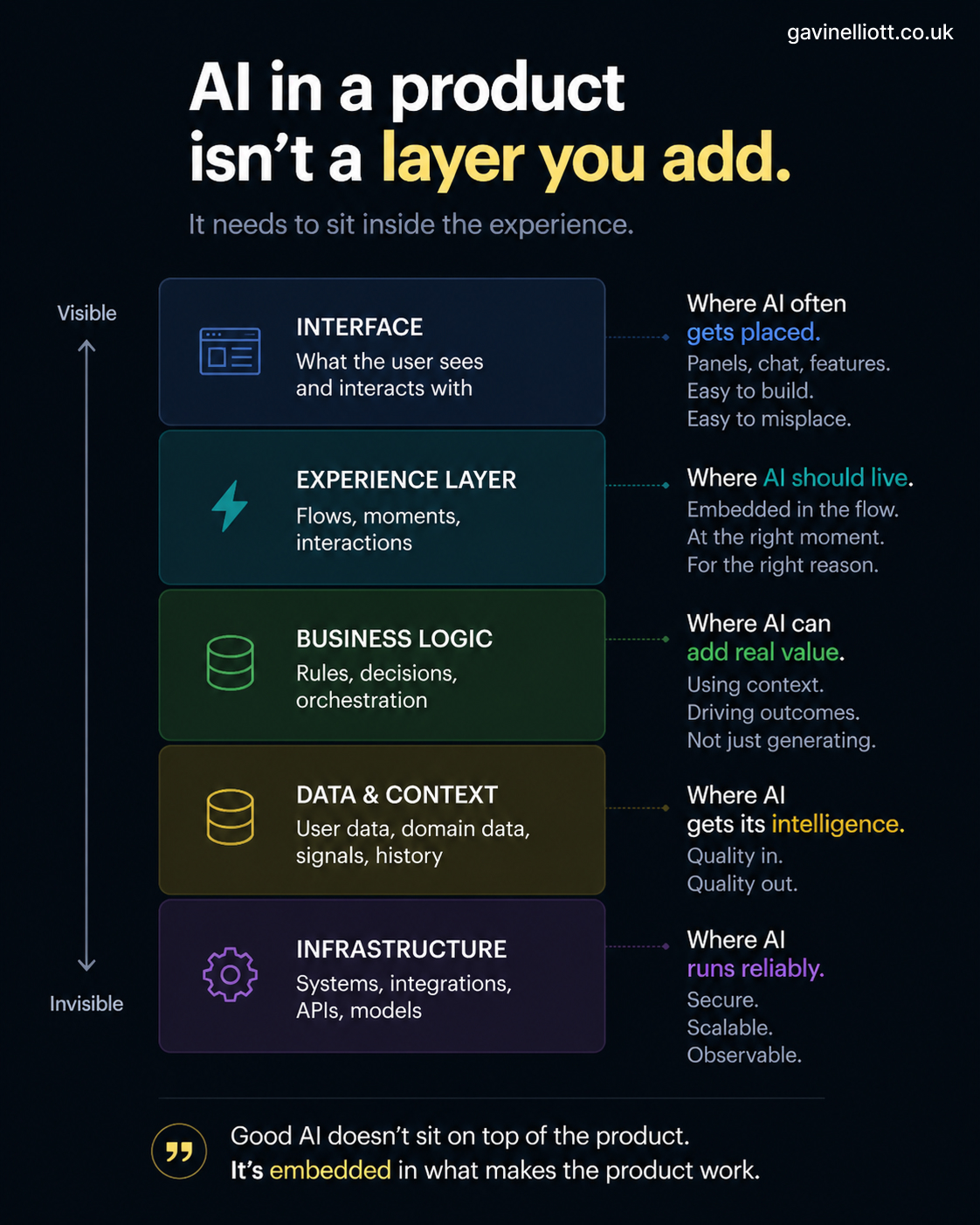
AI isn’t something you can just layer on top.
It needs to sit inside the experience.
At the right moment. For the right reason.
That’s where it starts to work.
Not as somewhere a user has to go to use it.
But something that shows up when it’s actually needed.
The difference is subtle, but important.
One feels like a feature.
The other feels like the product understands what’s happening.
Why placement matters more than capability
There’s a lot of focus right now on what AI can do.
And in many cases, the capability is already there.
That’s not the limiting factor.
The limiting factor is judgement.
Knowing:
– where AI belongs
– where it doesn’t
– what it should be doing
– when it should appear
Get that wrong, and even a strong capability feels unnecessary.
Get it right, and it feels obvious.
Where most implementations go wrong
Most AI features are designed as destinations.
Places you go to interact with it.
A panel. A tool. A separate space.
But that breaks the flow.
It creates friction where there shouldn’t be any.
And it removes context.
Which is often the most important part.
What better looks like
The more effective implementations I’ve seen don’t draw attention to themselves.
They’re embedded.
They show up inside existing journeys.
They’re triggered by something that’s already happening.
And they help move things forward.
Not by being visible.
But by being useful.
Closing
Most AI features don’t fail because the technology isn’t good enough.
They fail because they’re placed in the wrong part of the experience.
And until that changes, we’ll keep seeing things that feel impressive.
But not actually useful.